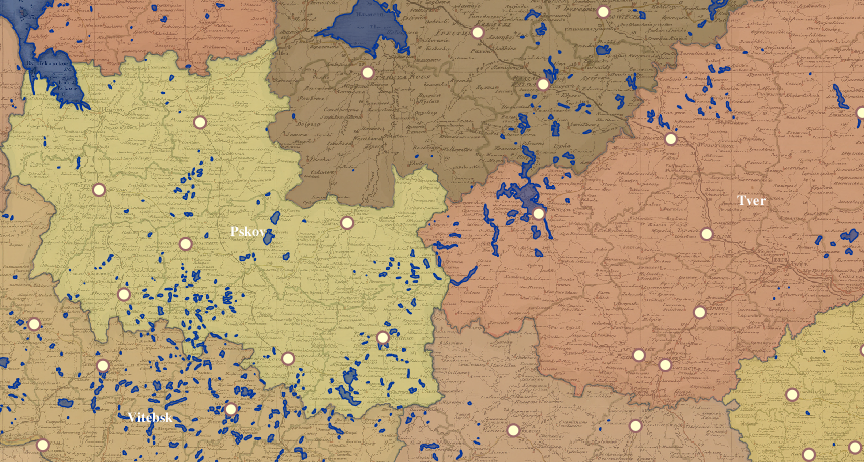
The Piadyshev Atlas contains attestations of 459 district (uezd) towns. This is a bit odd, given the fact that the atlas describes 591 districts. How might we make up - or at least explain the shortfall?
To start, the 43 districts in the Grand Duchy of Finland, the 8 voevodstvos in the Kingdom of Poland, the 24 domains (владения) and districts (округа) of the (former) Kingdom of Georgia, and the 7 nachal'stva of the Don Cossack territory lacked district seats per se, as these regions had different administrative structures than the rest of the empire. That brings the target number down to 509, from 592.
GIS software makes it incredibly easy to count the number of districts with at least one location designated as a district town: 444. In other words, the dataset is missing 66 district towns?
Happily, that is not the case. You see, in most cases, a district that was home to a provincial seat (gubernskij gorod) did not have a separate district town. That means that we can add our provincial towns to the count. 55 districts were home to provincial towns (excluding Okhotsk and Kamchatka, which were not organized as regular provinces), but in 5 cases the atlas shows the presence of both a provincial and a district town. Eliminating those redundancies, and treating provincial towns as district towns, we can now cover 494 districts.
What about the remaining 15?
Careful scrutiny reveals that according to the atlas, precisely 15 districts lacked district towns altogether (3 in Iakutsk, 1 in Tavrida, 1 in Kavkazskaia oblast', 3 in Kharkov, 4 in Minsk, 3 in Vilensk).
The math is a dizzying and the explanations myriad, but the result is that the dataset in fact contains what it ought to, given the parameters of the source from which it is drawn.