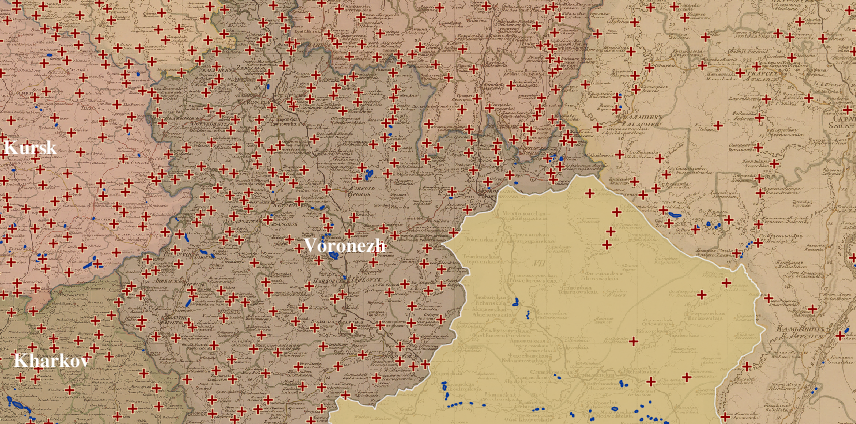
Villages came in several varieties, the derevnia and the selo being by far the most numerous. This layer describes the geography of the selo (село > села), the quintessential Russian village. A selo was generally a large rural settlement, the site of an Orthodox church, and a seat of peasant administration.
Digging Deeper
Several atlas sheets conflate sela with four other settlement types. That practice has been preserved in the Imperiia Project, for lack of any way to disambiguate the various types:
- большой двор (large homestead): Kurliand
- кирка малая (small parish): Grand Duchy of Finland
- погость (pogost'): Pskov, Novgorod, Tver, Moscow, Smolensk, Chernigov, Tula, Olonets, Vologda, Arkhangel'sk
- словода (sloboda): Poltava, Kharkov, Ekaterinoslav, Kursk, Kaluga, Iaroslav, Vladimir, Tambov, Voronezh, Viatka, Nizhnii Novgorod, Penza, Kazan, Simbirsk, Saratov, Don Cossack lands, Astrakhan, Kafkaz, Perm, Orenburg, Tobolsk, Tomsk, Enisejsk, Omsk, Irkutsk, Kamchatka, Iakutsk
The
sloboda was a settlement or group of settlements that had, originally, been exempt from the taxes and obligations imposed on most of the populace for a specified period of years. In return, inhabitants of the sloboda performed other tasks: garrison duty, household work, trade, crafts, etc. In areas of Siberia and in the Ukrainian lands the sloboda was used as a mechanism for attracting settlers and increasing agricultural activity.
The
pogost' was a feature of the northern reaches of Russia: a settlement complete with church, marketplace, and surrounding rural administrative district.