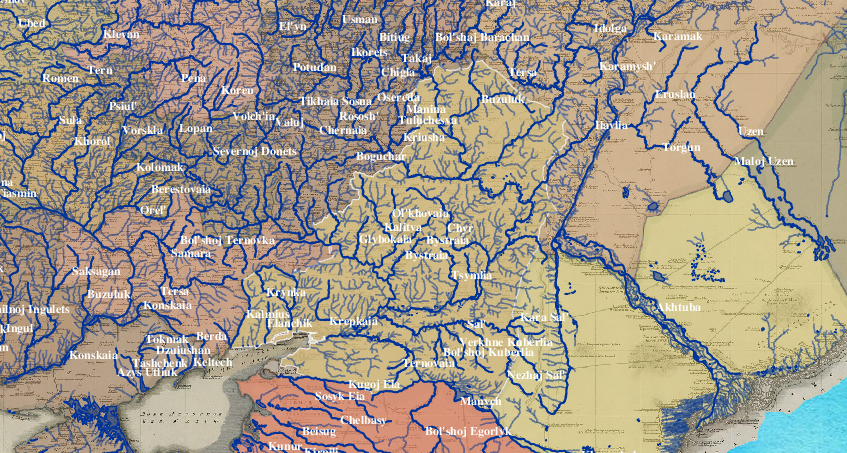
Russia was a riverine-boreal empire, replete with rivers ranging from the mighty Volga to the seasonal streams washing down hillsides in the Caucasian highlands. Rivers were a fundamental element of Russia's spatial profile, and they are a fundamental element of the Piadyshev atlas. The men of the Military-Topographical Depot of the Army General Staff scrupulously drew thousands of rivers, inscribing their courses and their names on each individual sheet, interrupting their graceful lines whenever they intersected a provincial boundary and picking up the watery narrative on the adjacent sheet.
As a result, these are two of the most substantial layers in the set. Altogether there are 21,997 features, most of which represent the full course of a river or stream. (In some cases, the course is broken up into segments.) Of these, 1,935 features bear toponyms (hydronyms, to be precise), 651 of which have been recorded. This subset is available on the Imperiia Map; the full set is available upon request and will be published in the Imperiia dataverse in coming months. The final version of the dataset will include the complete set of hydronyms.
For those of you keeping track of such things, the shortest river given a name on the Piadyshev atlas is the 28-kilometer Varuzha River in Vitebsk province. The longest - and the longest overall - is the Lena River, which stretches 3,712 kilometers (the modern measure is 4,472 kilometers) from the Baikal region to its mouth on the Arctic Ocean.