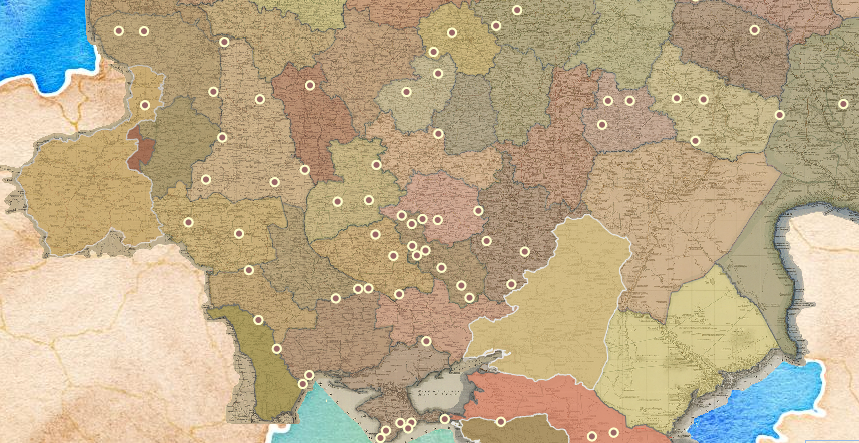
Russian law differentiated between towns that were, and towns that were not, seats of administrative power. In each district (uezd) there could be only one "district town" (uezdnyj gorod); other populated places that enjoyed the privileges of urban status were called zashtatnye goroda (заштатные города) or pripisnye gorod (приписные города).
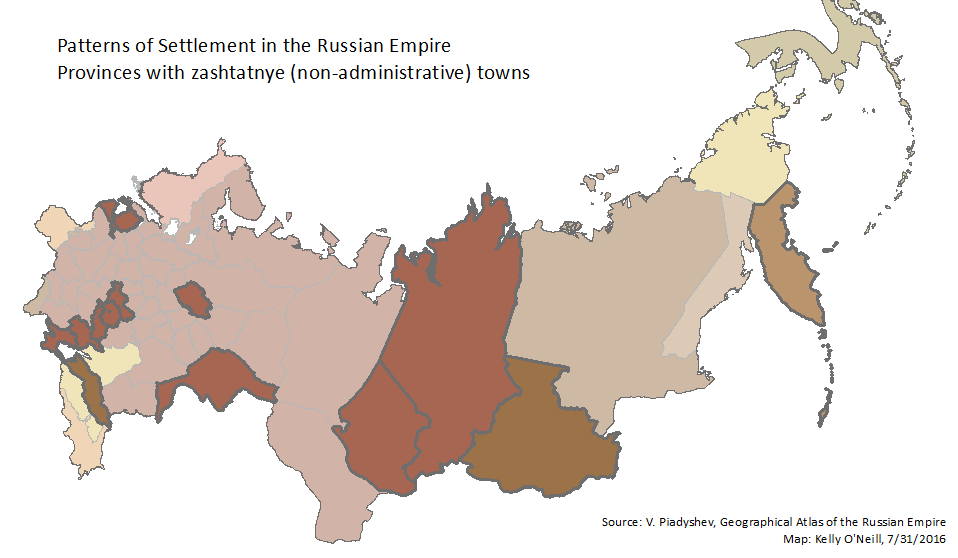
The Piadyshev atlas uses the same symbol to describe both zashtatnye and pripisnye towns. Pripisnye goroda, or registered towns, are the predominant form. The following provinces contain zashtatnye, rather than pripisnye, goroda:
- Kurliand (where they are called "ordinary" (обыкновенные) towns
- Lifliand (where they are designated "small" (малые) towns
- Estliand (where they are designated "small" (малые) towns
- Kharkov
- Ekaterinoslav
- Tavrida
- Kursk
- Orlov
- Kostroma
- Caucasus
- Orenburg
- Tomsk
- Enisejsk
- Irkutsk
- Kamchatka (where they are designated "non-uezd towns")
In Arkhangel'sk, Tobol'sk, and Iakutsk the legend includes a combined category (приписный или заштатный).