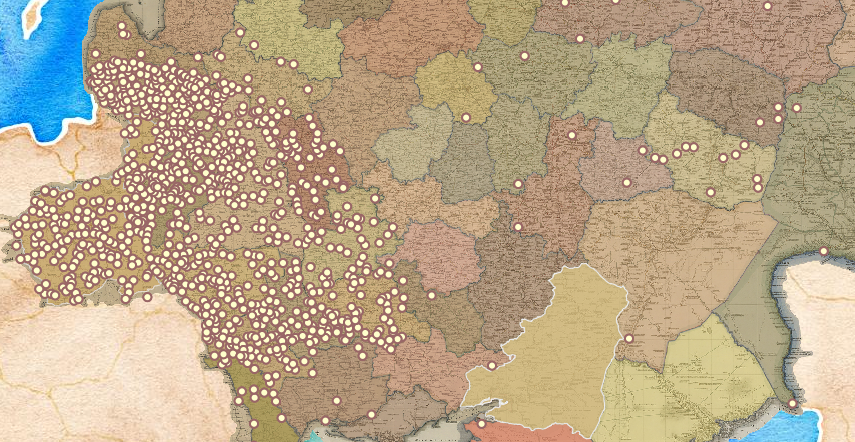
The "minor town" (mestechko/местечко) was distinct from other rural and urban settlement types. According to most sources, the mestechko had four distinguishing features:
- In ethnic terms, the inhabitants of a mestechko were generally Jewish.
- In social terms, the inhabitants of a mestechko were traders and/or craftsmen.
- In geographic terms, mestechka were located in the western provinces - those incorporated into the empire through the Partitions of Poland - and in the Caucasus.
- In administrative terms, in order for a settlement to be considered a mestechko, there must be an official meshchanstvo administration (мещанское управление) present.
That is, anyway, how the minor town is described in authoritative late nineteenth-century sources, such as the Brokgaus Efron Encyclopedia. At the time of the compilation of the Piadyshev atlas, it was a slightly more fungible category. Moreover, Piadyshev and company decided to use the same symbol to designate the presence of a mestechko, posad, or ostrog:
- Mestechko and posad: Pskov, Arkhangel'sk, Novgorod, Tver, Kostroma, Vladimir, Saratov, Vologda
- Mestechko and stanitsa: Voronezh
- Mestechko and ostrog: Tomsk, Enisejsk, Irkutsk, Iakutsk, Okhotsk
- Kamchatka: ostrog
As a result, the minor town has a broad distribution across the atlas, with 1,066 locations spread over 40 provinces, from the Polish provinces all the way to Kamchatka.