Layered Data
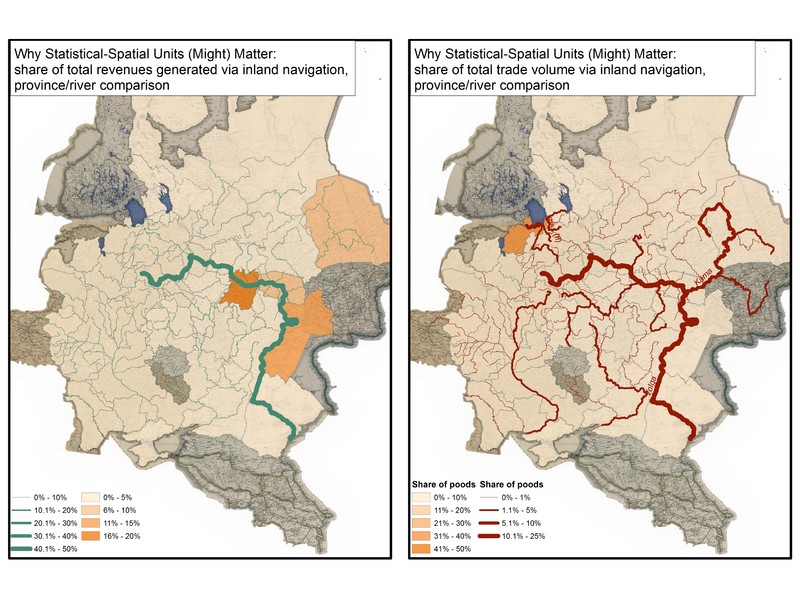
Layering and juxtaposing the original data on a map is, I would argue, the most effective way to demonstrate the geographical variability of the imperial economy. Mindful of the ubiquitous caveat (ubiquitous in the context of this essay, that is) that here we are examining the internal economy through the lens of a single dataset, we can begin to put some meat on the bones of that seemingly too-obvious-to-linger-over idea.
First, if we are trying to determine the relative significance of Russian rivers, perhaps we need to think more carefully about how we define the term. Are we interested in the value or volume of trade? Why might it matter? Well, this mosaic suggests that while the Volga was far and away the main generator of rubles from inland navigation, roughly a dozen rivers played key roles in shipping volume. While these admittedly amateurish maps might not get us any farther than that, they do suggest that it isn't enough to describe the economic life of the Volga and think that we have done our job.
Second, if we are interested in digging into the implications of inland navigation for provincial or local economies, these maps suggest that there are all sorts of nuggets to mine. For starters, though both Nizhnii Novgorod and St. Petersburg look like provinces with thriving riverine trade, the scale and intensity of their economies are quite different. Even more tantalizingly, Russia's riverine infrastructure clearly impacted different parts of the empire in different ways. A nuanced spatial approach - one that incorporates proximity, density, and distribution, along with other data on climate and topography - will allow us to shed the constraints of the "economic backwardness" narrative and embrace new histories of what the imperial economy was, rather than what it wasn't.
Third, if we are interested in generating researching questions (either for ourselves or, in many cases, for our students), mapping can be a fruitful endeavor. These layered maps for example, limited in scope as they are, might lead us to wonder about the seeming inconsistencies in the value & volume of trade in Perm or Nizhnii, or along the Don or Volkhov, etc.