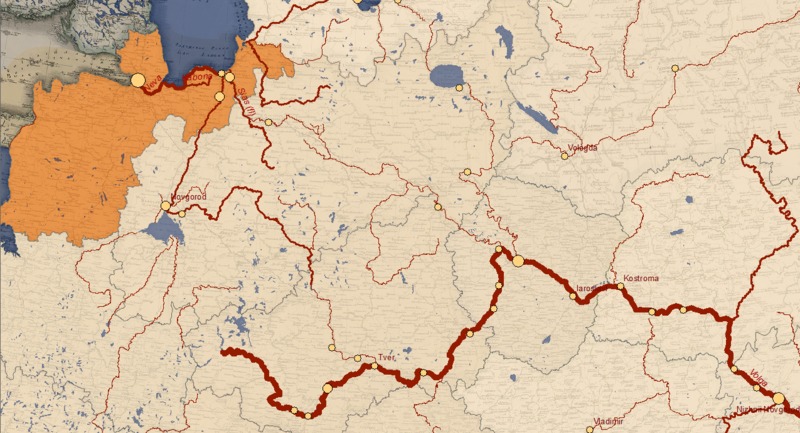
Suggestive Geographies
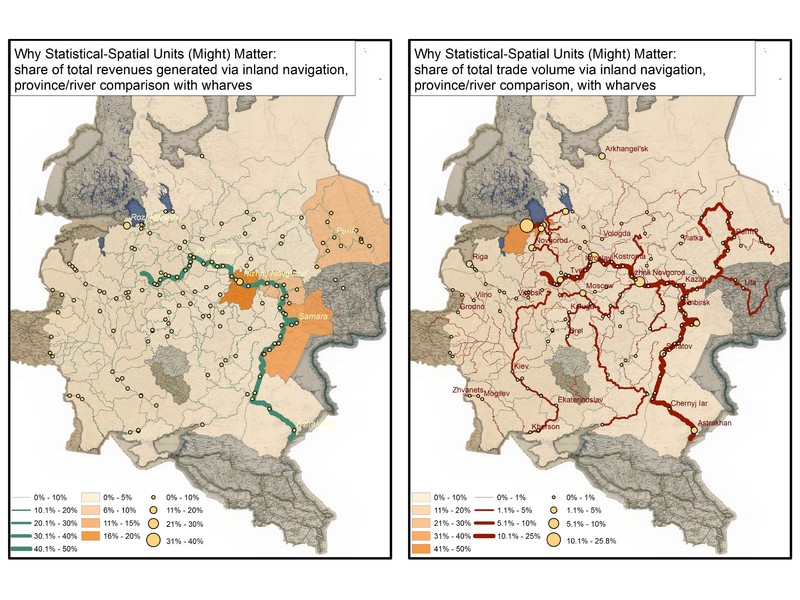
Finally, mapping allows us to put an array of otherwise incompatible data into a coherent analytical space. While I suppose there are human beings who are capable of simultaneously sorting and comparing data describing points (settlements or wharves), lines (rivers or roads), and polygons (administrative units), I am not one of them and I would like to believe that I am not alone. This is the realm in which GIS excels. This is what is was made to do: to facilitate a kind of spatial thinking and spatial analysis that is as necessary to understanding the fullness of human experience as it is (nearly) impossible to manage with pencil and paper.
This last mosaic is, I hope you will agree, a dramatic improvement over the one on ther previous page. Here, thanks to the addition of a layer depicting the location of river wharves involved with domestic trade, we start to get a sense not just of macro-level production of rubles and poods, but of movement, and of the distribution or intensity of economic interactions.
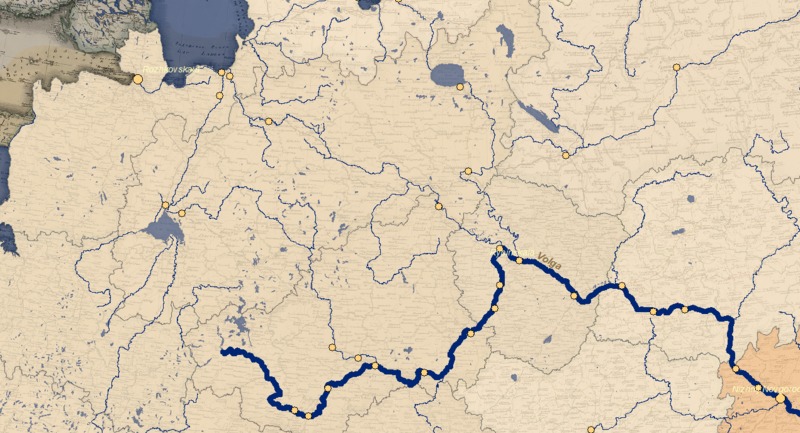
In order to speak of such things with any degree of authority or in any detail one would need to incorporate far more fine-grained data. Nevertheless, the maps in this mosaic begin to tell a story about the imperial economy: a story that complicates our sense of center and periphery; begins to carve out meaningful space for small-scale interactions; gestures toward the iterative and unique qualities of economic life; and suggests the utility of maps and mapping - making them as well as interrogating them - for studying the infrastructures that shaped the empire.